Striking Works.
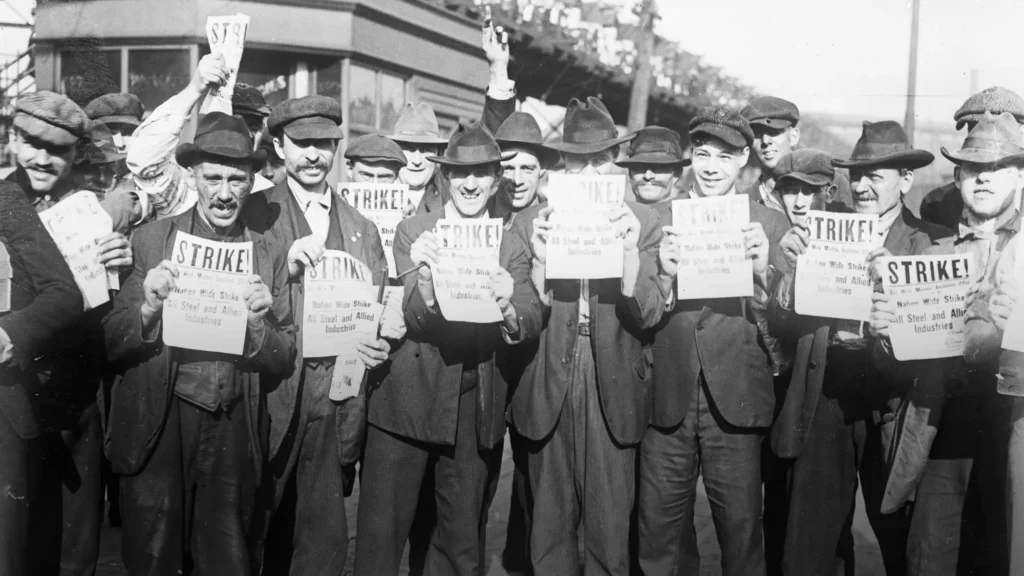
Historically, striking has been one of the most effective methods the working class has used to achieve our goals.
How To Do It
A GENERAL STRIKE is a widespread work stoppage, involving a significant portion of the work force, across multiple industries or an entire region.
It’s typically not just one event; it’s a series of strikes, undertaken by regular people, who do not let up until broader systemic demands are met.
It’s one of the most powerful tools we have to affect change across our whole society.
How Does It Work?
A general strike is a powerful tool to resist fascism and executive overreach because it disrupts the normal functioning of a society and asserts popular power outside traditional political channels. Here’s how:
A general strike halts work across multiple sectors: transportation, manufacturing, education, healthcare, etc. This cripples the economy. Governments, especially authoritarian ones, often rely on economic stability to maintain control. Disruption of that stability creates leverage, which the strikers can then use to negotiate.
Fascism thrives on obedience, fear, and conformity. A general strike is an act of mass non-cooperation—millions refusing to follow orders, produce, or comply. This breaks the illusion of total control and inspires others to resist.
When executive power overreaches (e.g., bypassing legislatures, silencing courts or media), traditional checks and balances may fail, as they are doing today. A general strike serves as a popular check—a form of direct action to pause the system and demand accountability.
Do General Strikes Really Work?
Strikes can work remarkably well when there are clear and unified demands, widespread participation, strong leadership. public sympathy, and political or economic vulnerability.
Here are some examples of effective, large-scale strikes:
A student revolt, which led to a general strike that eventually involved 10 million workers, nearly toppled the government of Charles de Gaulle and led to worker wage increases and labor reforms.
A strike of shipyard workers led to the creation of a strike-based movement that forced the repressive communist government of Poland to negotiate and allow for freer and fairer elections. As a result, the citizens of Poland were able to vote out the communist-party insiders, leading to the fall of the communist regime in Poland and the Eastern Bloc.
This movement, which gradually escalated through the 1980s, culminated in a wave of protests and strikes of Black labor that shook the foundation of South Africa’s Apartheid-era economy. This movement contributed to the dismantling of South Africa’s apartheid in the early 1990s.
From generalstrikeus.com: